
What makes a good neighbor? People learned it's someone who is there, after singer/songwriter Barry Manilow made "like a good neighbor" a hit advertising jingle for State Farm's insurance business in …
This item is available in full to subscribers.
To continue reading, you will need to either log in to your subscriber account below or purchase a subscription.
Please log in to continue |
What makes a good neighbor? People learned it's someone who is there, after singer/songwriter Barry Manilow made "like a good neighbor" a hit advertising jingle for State Farm's insurance business in 1971.
Edward Rust Jr., now retired chairman of the board at State Farm, believed it was someone to be trusted, someone to count on, someone who cares.
Wrangell's Friends and Neighbors program is doing just that, but without insurance premiums and without an ad jingle. In order to address the practical and social needs of local elders, the program resumed in February to pair volunteers (Friends) with elders (Neighbors).
The program was active before the pandemic shut down in-person visits but now has restarted.
Alice Rooney, who developed and coordinates the program in conjunction with nurse Chris Bue, explained the concept: "You do the kinds of things neighbors do, like have a cup of coffee and chat, or play some cards, or run a couple of errands."
Judy Bakeberg says having a Neighbor visit is "really nice, it breaks up the day. I enjoy having someone to talk to," though not during a Mariners' baseball game.
Her daughter Leslie Cummings reached out to the program after Bakeberg had some health issues and anticipated having to move to Juneau. "The Friends and Neighbors program was a resource that allowed my mom to stay in her home," Cummings said.
"Those visits every couple of weeks mean I am not the only one checking in on her, and it's fun for her to tell stories I've heard over and over to new people."
Rooney says the volunteer commitment is three to nine hours a month, for at least six months. She emphasizes the program is a social resource, not a health care resource. Volunteers do not provide personal care, handle finances or do heavy chores. Visits are generally home-based, but the program does have an insurance waiver if the pair go on an excursion.
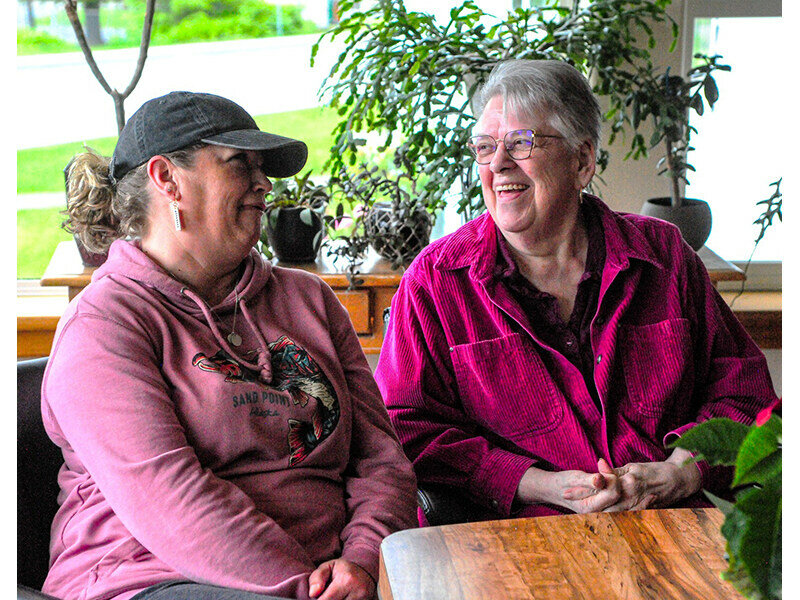
Christy Park and her Neighbor Dorothy Christian have gone to the library, the community market, and even to the Milk Run Music Fest. "It just depends on the day," Park said. "We might connect for 10 minutes or two hours. Our relationship is sometimes a comedy of errors. Alice did a fantastic job of pairing us. This was something the both of us wanted and needed. She's a character and we have lots of fun."
Rooney says the paring process is based on interviews; she looks for shared interests or other connections. She attends the initial meeting, to make the introductions and help break the ice. She said some of the pairs already knew each other; joining the program just enhanced and formalized the relationship.
Park added that the experience is humbling, and gives her an overall good, happy, warm feeling.
She encourages other people to consider volunteering for the program, as it gives a sense of community to help out however and wherever you can. But, she said, "don't volunteer if your heart is not into it. I appreciate the fact that people see good in it, but that's not why I am doing it. It's not about what I get out of it, but what they get out of it - a sense of independence and freedom."
There are currently 11 volunteers and eight elders in the program. If you are interested in becoming a Friend, or know someone who would be a good Neighbor, contact Rooney at 907-305-0007 or email her at rooney@aptalaska.net.


